After three months of work, the coursework side of media has finally come to an end. I feel a sense of both pride and relief.
Goodbye blog. xx
Thursday, April 1, 2010

Sunday, March 28, 2010
Evaluation Question 7
Looking back at your preliminary task, what do you feel you have learnt in the progression from it to the full product?
Preliminary task brief:
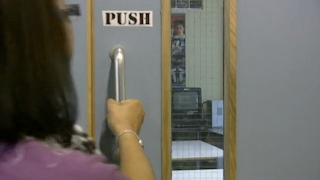
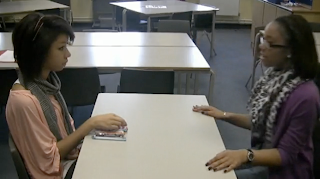
A short continuity task in which we had to film a character walking into a room through the door, sitting down on a chair and talking to another character briefly.
Main task brief:
To film the opening two minutes of a film based on the genre and storyline of your choice. It should last around two minutes.
During each tasks, there are three main stages:

During the preliminary task, I was able to refresh my memory on what I needed to know.
1. Planning:
This stage involved:
 Since GCSE Media, I'd forgotten about the planning stage of the project and i found this extremely useful, especially as things like shot lists and shot logs can prove to be extremely helpful in the future.


Preliminary task brief:
A short continuity task in which we had to film a character walking into a room through the door, sitting down on a chair and talking to another character briefly.
Main task brief:
To film the opening two minutes of a film based on the genre and storyline of your choice. It should last around two minutes.
During each tasks, there are three main stages:

1. Planning:
This stage involved:
- organising group meetings.
- ensuring paperwork was correctly filled out.
- roughly storyboarding.
- hiring out equipment.
- choosing a location and actors
- writing a script.

2. Production
During production we had to:
- assign group members roles. (eg. cameraman, sound checker)
- sort out timings
- achieve perfect continuity
- establish our master shots, cutaways etc.
- film all our shots fully from each angle
- learn the continuity rules (eg. 180 degree rule)
The fact that we were working in a team meant that everybody had to learn to communicate. This was a major skill that we all had to develop in order to produce a successful sequence with good narrative flow and continuity.

3. Editing
During editing we had to:
- capture all footage.
- learn to use adobe premiere pro.
- add a title(s)
- cut the shots accurately and put them together so the continuity looked seamless (eg. when ella opens the door and we cut from her outside to her walking inside the room.)
- make sure the sequence made sense and was a suitable length.
I felt that this was the stage where i learnt the most - i learnt to make titles again and i was able to re-familiarise myself with the software, which i had forgotten about.

One useful thing i learnt was to place clips on alternating rows rather. So i'd place one clip on 'Video 1' and the next clip on 'Video 2' etc. This meant that seeing where one clip started and another ended was very easy.
As well as those 3 stages, i had to evaluate my preliminary task - this was based on the finished piece and teacher/fellow media student's feedback. I had to state what i had learnt, what i'd do differently, what worked etc. I also had to write how i felt the preliminary task would help me in the future:

Finally, learning to work as part of a team was vital. We had to take it in turns to shoot, edit and do paperwork. I learnt to pull my own weight and to help motivate the rest of the team at times to produce a successful final piece.

Evaluation Question 6
What have you learnt about technologies from the process of constructing the product?
During the production of our sequence, we used a mixture of different types of hardware and software. The hardware was used in the practical side of filming the piece and the software was used to edit and enhance our sequence.
Hardware:
During the production stage, we used many different types of hardware, some of which I had never used before, such as the cannon DM50 directional stereo microphone. I learnt what each piece was called and what each was used for:

I remembered these pieces of hardware from GCSE Media. However, I had forgotten how to use things such as the Paglight and how to extend the tripod - I ensured that before filming anything I learnt how to confidently use each piece of equipment and I felt I learnt alot from doing this.
All of these things had similar advantages - they were all relatively easy to carry around and nothing was too large. We were careful with the equipment and after the health and safety session at school we were very unlikely to break anything or harm ourselves using anything. A particular piece of equipment that i felt had the most advantages was the tripod - it was easy to fold up, change its levels and carry it around in its case. The battery life on the camera battery was also very good and we never ran out of battery.
The equipment also had disadvantages - we constantly had to be careful with the paglight as the barn doors kept closing, which is a fire hazard so they required lots of attention.
Software:
Learning to use software well was extremely important - we may have filmed our shots but editing a continuous and impressive sequence was going to take time, effort, skill and knowledge of all the software.
 This programme was called Adobe Premier Pro CS3. It was the main programme that was used throughout the editing weeks - it was used to capture footage, piece it together, cut it, add transitions, add music etc. We used to basically do almost everything.
There were many advantages of this software - it was easy to use following the lesson on how to use it and we were able to do the majority of our work on it. We were able to create numerous timelines so testing out effects was easy too. However, the disadvantages were that I felt the transitions on offer were fairly basic and we couldn't create titles/credits using it so we had to use the mac instead.
 This was the programme on the mac, known as Livetype, which we used to create our titles. It had so many advantages - we were able to choose from a wider variety of fonts and the transitions were much more impressive then on the PC's. I was able to use the programme with ease, despite never having used it before and I feel our titles were successful. The only disadvantage of the programme was that we had to export our titles from the mac to the PC whenever we made them, which took extra time and could get annoying.
 This programme was also on the mac and was called Soundtrack Pro. It was really useful as we were able to find a huge library of sound effects on here - we found the sound effects for 'GPH Productions' and 'Heartbeat Films' on here. The advantages were that i found this programme easy to use and it gave us a wide selection of material to choose from. However the disadvantage with this programme was the same as with Livetype - exporting things could get irritating.
Advice to others:
During the production of our sequence, we used a mixture of different types of hardware and software. The hardware was used in the practical side of filming the piece and the software was used to edit and enhance our sequence.
Hardware:
During the production stage, we used many different types of hardware, some of which I had never used before, such as the cannon DM50 directional stereo microphone. I learnt what each piece was called and what each was used for:

All of these things had similar advantages - they were all relatively easy to carry around and nothing was too large. We were careful with the equipment and after the health and safety session at school we were very unlikely to break anything or harm ourselves using anything. A particular piece of equipment that i felt had the most advantages was the tripod - it was easy to fold up, change its levels and carry it around in its case. The battery life on the camera battery was also very good and we never ran out of battery.
The equipment also had disadvantages - we constantly had to be careful with the paglight as the barn doors kept closing, which is a fire hazard so they required lots of attention.
Software:
Learning to use software well was extremely important - we may have filmed our shots but editing a continuous and impressive sequence was going to take time, effort, skill and knowledge of all the software.

There were many advantages of this software - it was easy to use following the lesson on how to use it and we were able to do the majority of our work on it. We were able to create numerous timelines so testing out effects was easy too. However, the disadvantages were that I felt the transitions on offer were fairly basic and we couldn't create titles/credits using it so we had to use the mac instead.


Advice to others:
- I'd advise people to have a health and safety session before handling any hardware
- Have sessions using the software experimentally before using it properly
- Constantly press ctrl+s to save work whilst editing to ensure nothing is lost
- If you're ever unsure of anything, ask.
Evaluation Question 5
How did you attract/address your audience?
During our opening sequence, we wanted to evoke the following reactions from our audience:


During our opening sequence, we wanted to evoke the following reactions from our audience:
- shock
- intrigue
- curiosity
- surprise
- empathy

Some of the above reactions are known as 'audience pleasures' - these are things that the audience want to feel when they watch a film. If you're watching a crime-thriller then you want surprises in the plot and you want to feel curious about what is has happened/is happening/about to happen.
Shots during the screening:

We wanted the audience to be able to relate to and empathise with our main character - this is why we have her trip and giggle at the start, to give her some personality so the audience feel they know more about her.
In order to evoke these reactions, we used a number of techniques. We used cross cutting to keep the audience's attention - when we showed our first edit (click here) the audience seemed to get slightly bored with the long continuous shots. To solve this problem, we decided to cross-cut instead.

We also built up the attack with the use of increasingly dramatic music and choppy shots to let the audience know something big was about to happen, building up the enigma.
In order to attract the audience, we advertised our screening through the social networking sight facebook:

This was very successful, and our screening attracted around 50-60 people.
Evaluation Question 4
Who would be the audience for your media product?
We aim to target a younger audience of older teenagers to young adults who enjoy realistic and intelligent movies.

Our audience is quite niche hence the reason that we think our movie would be shown at smaller cinemas that deal with more independent movies, such as the Phoenix, East Finchley.

We included young actors and confronted the young audience with a situation that could happen to anybody - this gets our audience thinking about the movie and wanting to watch the rest of it.
It's something that could happen to anybody in our target audience regardless of lifestyle, nationality etc. The audience can LEARN from our film.
We also realised that our film could have a secondary audience of those over the age of 25 who simply enjoy the theme of crime. Since our film would be focused around an investigation into the rapist and his past crimes, those who enjoy crime thrillers in general may also want to watch our movie. This broadens our target audience, helping us to reach more people.
We aim to target a younger audience of older teenagers to young adults who enjoy realistic and intelligent movies.


We included young actors and confronted the young audience with a situation that could happen to anybody - this gets our audience thinking about the movie and wanting to watch the rest of it.
It's something that could happen to anybody in our target audience regardless of lifestyle, nationality etc. The audience can LEARN from our film.
We also realised that our film could have a secondary audience of those over the age of 25 who simply enjoy the theme of crime. Since our film would be focused around an investigation into the rapist and his past crimes, those who enjoy crime thrillers in general may also want to watch our movie. This broadens our target audience, helping us to reach more people.

Evaluation Question 3
What kind of media institution might distribute your media product and why?
Our production company is called GPH Productions. We focus on making gritty, realistic and hard hitting movies that deal with current issues for those who enjoy more intense thrillers. We're trying to reach an audience of intellectual older teenagers and younger adults. Because of our niche audience we'd expect our movie to be independent and released at smaller cinemas such as the Phoenix, East Finchley.

One of the movies we looked at previously was 'The Last House on the Left' (2009, Iliadis). It was also focused around rape and this film was produced and distributed by the company Rogue Pictures. Rogue Pictures distribute other films of a similar genre (ie. thriller/horror) such as 'The Hitcher' and 'The Strangers.'


We would start off by exhibiting our film at film festivals such as the 'Sundance Film Festival.' An example of a successful film that was screened there is 'Paranormal Activity, Peli, 2009,' and independent movie which became a huge success.


Our production company is called GPH Productions. We focus on making gritty, realistic and hard hitting movies that deal with current issues for those who enjoy more intense thrillers. We're trying to reach an audience of intellectual older teenagers and younger adults. Because of our niche audience we'd expect our movie to be independent and released at smaller cinemas such as the Phoenix, East Finchley.

One of the movies we looked at previously was 'The Last House on the Left' (2009, Iliadis). It was also focused around rape and this film was produced and distributed by the company Rogue Pictures. Rogue Pictures distribute other films of a similar genre (ie. thriller/horror) such as 'The Hitcher' and 'The Strangers.'

Our distribution company was called 'Heartbeat films' implying that they distribute movies that make your heart beat ie. Dramatic, intense fims.


Since our film is focused around a British female teenager from London, we would also try screening our film at the London Independent Film Festival as the audience that would be able to relate to the movie the most would be reached through this platform of exhibition.

Evaluation Question 2
How does your media product represent particular social groups?
The main social group depicted in our opening sequence are typical female teenagers in their late teens. An example of a character like this is Effie from Skins, a character that inspired us when choosing an actress to play our main character.
 We tried to repsent this social group through the way Georgia was dressed ie. heels, leather jacket, black skirt:


The main social group depicted in our opening sequence are typical female teenagers in their late teens. An example of a character like this is Effie from Skins, a character that inspired us when choosing an actress to play our main character.


We also showed how she was rebellious through her drunken trip (adding a slow motion hazy effect when Georgia trips) and her smoking before she enters her flat - we did not try to show them in a bad light, we simply showed what many female teens are like.

Friday, March 26, 2010
Evaluation Question 1
In what ways does your media product use, develop or challenge forms and conventions of real media products?
Genre: What genre did we feel our movie would fall under? Thriller. A thriller is made to keep the audience on edge. It contains many twists and turns making the audience constantly ask questions - this can be unbearable for them.

As shown above, the thriller genre has many sub-genres. 'The Safehouse' fits into the Crime-Thriller sub-genre.

We want our audience to have to examine the backstories and motivations of our main characters and to feel somewhat involved in the movie and to become immersed in it.
Examples of crime thrillers include:




Genre: What genre did we feel our movie would fall under? Thriller. A thriller is made to keep the audience on edge. It contains many twists and turns making the audience constantly ask questions - this can be unbearable for them.

As shown above, the thriller genre has many sub-genres. 'The Safehouse' fits into the Crime-Thriller sub-genre.

We want our audience to have to examine the backstories and motivations of our main characters and to feel somewhat involved in the movie and to become immersed in it.
Examples of crime thrillers include:
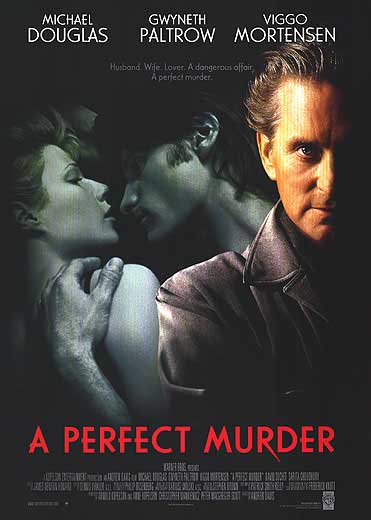
- A Perfect Murder, Davis, 1998
- Seven, Fincher, 1995

Both these films include typical characteristics of the crime-thriller genre - We have one clear 'goodie', 'baddie', dark scenes in shadow, tense music and the sequence increases in pace - these are common of thriller.


Do we challenge conventional crime thrillers? Yes.
We have a female heroin and the whole movie is from her point of view, as opposed to from a male's point of view eg. Seven.

We also cross-cut between the present and past events.
Narrative Structure: Conventionally, films have a closed narrative in which time is compressed. (Two hours constructs events happening over months or years) The opening tells us the WHO, WHAT and WHERE of the story and we usually see a series of events crucial the rest of the film's development.
Typically, a film:

this is based on Todorov's theory.
A buildup to the event is shown through jumpier and shorter clips and the sequence is not shown in real time - we include flashbacks and crosscutting between the past and present.
The action code is clearly set up - the who (victim), the where (her flat), and then when. ("It was the 28th February 2010...")
The enigma code is also set up clearly as the audience wonder why our victim was chosen by the rapist. These follow Barthes' theory.
Form:

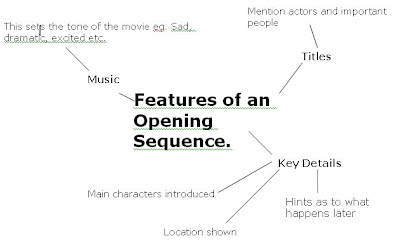
Our film does conform to these typical features of opening sequences, as demonstrated in the grid of screenshots below:

Comparing our opening sequence to that of 'Seven':

Despite the fact that Seven is of the same genre as The Safehouse, the opening sequence for it is very different. Yes, the main character is introduced but we never actually see his face and it's all alot more mysterious with far more ECU's. There's alot more detail too - however, like our opening sequence there's tense music in the background and titles are also included.
Style:
Music; Initially, the music is sad but it slowly changes to tense and dramatic with a loud ending when the attack happens. The dialogue is all straight to the point (eg. "I'm here to talk about my rape experience.") showing that our movie will be gritty and realistic. The pace increases building up to the attack.
Titles; 'typed' up as though an investigation piece is being written.

Use of Binary Opposites;
Between the shots of Georgia talking to the camera and the flashbacks, we included lots of binary opposites through her clothing (tight to baggy), the lighting (dark to light) and the camerawork (jumpy to static):

Tuesday, March 16, 2010
Editing Week 2 - 15th March
Last week we managed to do alot on our opening sequence - we put all the clips in order, got our music sorted, did the titles and added sound effects to them.
We're aiming to get signed off by Wednesday morning, leaving the triple media lesson on Friday for any snagging etc.
We experimented with changing the order of the clips - instead of having just Georgia talking at the beginning, we tried alternating between clips of her talking and clips of her walking and getting attacked. We compared the sequences and found we preferred the first and original order as the music fitted perfectly and we felt that the sequence 'flowed' alot better.
Finishing Touches: We need to do our production logo and include it at the beginning of our opening sequence. We also need to improve the title for 'The Safehouse.'
We're aiming to get signed off by Wednesday morning, leaving the triple media lesson on Friday for any snagging etc.
We experimented with changing the order of the clips - instead of having just Georgia talking at the beginning, we tried alternating between clips of her talking and clips of her walking and getting attacked. We compared the sequences and found we preferred the first and original order as the music fitted perfectly and we felt that the sequence 'flowed' alot better.
Finishing Touches: We need to do our production logo and include it at the beginning of our opening sequence. We also need to improve the title for 'The Safehouse.'
Tuesday, March 9, 2010
Editing Week 1 - 8th March...
So we've definitely finished shooting our footage - I'm really relieved, it was definitely the most stressful part of the whole coursework experience. Now editing is our priority and I'm feeling more confident that our final sequence will be a success. I'll update my blog from now on, writing down what the group managed to do:
Monday 8th: This was yesterday - we only had a single period to work on our sequences today. We captured some of the footage and had a session on the mac computer with Ryan - he showed us extra effects we could add to our sequences that Windows cannot do.
Tuesday 9th: Today was had two periods of media and half of lunch to edit. We finished capturing our footage and put alot of it together roughly, slowly forming our opening sequence. We had to make sure it had good continuity and we began to think about extra effects we wanted to add in the near future. This week will be an intensive editing week as next week, Despina will not be here due to the Geography field trip.
Monday 8th: This was yesterday - we only had a single period to work on our sequences today. We captured some of the footage and had a session on the mac computer with Ryan - he showed us extra effects we could add to our sequences that Windows cannot do.
Tuesday 9th: Today was had two periods of media and half of lunch to edit. We finished capturing our footage and put alot of it together roughly, slowly forming our opening sequence. We had to make sure it had good continuity and we began to think about extra effects we wanted to add in the near future. This week will be an intensive editing week as next week, Despina will not be here due to the Geography field trip.
Tuesday, March 2, 2010
Thoughts so far...
I havn't blogged on my personal blog in a while - so far on the project, we've done our test shoot which was weeks ago. We used it mainly to experiment with shots and test out some ideas. It wasn't very successful in terms of creating a rough opening sequence but it did make us realise that we needed new actors and that we needed to uncomplicate the storyline a bit.
For the more final shoot, we did change our actors - we used Georgia as our victim and George as our rapist since his leg was better and he was able to do it. This was a really good decision. As well as this, we made our storyline less complicated - it's now just about a girl who was out partying and who gets attacked whilst going back into her flat. The simple storyline means we can focus more on the filming rather than explaining a long story in two minutes.
Our real shoot was the weekend that just passed (28th Feb) and it was definitely more successful than the test shoot in terms of acting and scripting. However we're still unhappy with some of the shots and we're going to do a final final shoot Wednesday evening between 6-9 to get the extra shots we want.
For the more final shoot, we did change our actors - we used Georgia as our victim and George as our rapist since his leg was better and he was able to do it. This was a really good decision. As well as this, we made our storyline less complicated - it's now just about a girl who was out partying and who gets attacked whilst going back into her flat. The simple storyline means we can focus more on the filming rather than explaining a long story in two minutes.
Our real shoot was the weekend that just passed (28th Feb) and it was definitely more successful than the test shoot in terms of acting and scripting. However we're still unhappy with some of the shots and we're going to do a final final shoot Wednesday evening between 6-9 to get the extra shots we want.
Thursday, January 28, 2010
Character Representation.
Having decided our final group idea, I've decided to research how our main characters (therapist, victim, rapist) have been represented in other movies.
Therapist:
 1. [Analyze This, 1999]
The therapist here is a caucasian male aged around his late 40s/early 50s. His costume is simple - he wears a plain white shirt and a plain black tie (although you can't see in it in this photo). He has facial hair and a receeding hairline, making him looks older.
He also wears glasses - these help him to look intelligent and experienced in his field.
 2. [A Girl Thing, 2001]
Here, the therapist is a female rather than a male. However there are similarities between them - she is also middle aged (albeit slightly younger, perhaps in her early 40s) and she also dresses simply and professionally wearing a plain red shirt and a grey suit.
 3. [Freaky Friday, 2003]
Again, the therapist in Freaky Friday was a woman - she also seems to be a similar age to the two therapists above and like them, she's dressed very simply and professionally. When it comes to choosing the costume and overall look for the therapist in our film, we'll need to choose somebody who looks mature and we'll need to dress them in smart, professional and simple clothing.
 1. [The Accused, 1988]
Therapist:
 1. [Analyze This, 1999]
 The therapist here is a caucasian male aged around his late 40s/early 50s. His costume is simple - he wears a plain white shirt and a plain black tie (although you can't see in it in this photo). He has facial hair and a receeding hairline, making him looks older.
He also wears glasses - these help him to look intelligent and experienced in his field.

Here, the therapist is a female rather than a male. However there are similarities between them - she is also middle aged (albeit slightly younger, perhaps in her early 40s) and she also dresses simply and professionally wearing a plain red shirt and a grey suit.
 3. [Freaky Friday, 2003]
 Again, the therapist in Freaky Friday was a woman - she also seems to be a similar age to the two therapists above and like them, she's dressed very simply and professionally. When it comes to choosing the costume and overall look for the therapist in our film, we'll need to choose somebody who looks mature and we'll need to dress them in smart, professional and simple clothing.
Victim:
 1. [The Accused, 1988]
Tuesday, January 26, 2010
Initial Ideas for Opening Sequences.
Initial Idea 1:
An opening sequence focused around a young man in his early twenties. He's just accidentally killed a man whilst driving carelessly - being too scared to contact the police, he drags the body miles away and tries to hide the evidence and cover his tracks. The opening sequences features ECU's on the man sweating, and clips where he's frantically washing his hands, his eyes twitch frantically around him etc. He looks extremely nervous and edgy and at the very end of the sequence we zoom out to see his car windscreen smashed and bloody.
 The rest of the movie would be about the sacrifices he has to make to avoid getting caught by the police, the run ins he has with them and how he struggles to live normally, constantly being paranoid and terrified.
An opening sequence focused around a young man in his early twenties. He's just accidentally killed a man whilst driving carelessly - being too scared to contact the police, he drags the body miles away and tries to hide the evidence and cover his tracks. The opening sequences features ECU's on the man sweating, and clips where he's frantically washing his hands, his eyes twitch frantically around him etc. He looks extremely nervous and edgy and at the very end of the sequence we zoom out to see his car windscreen smashed and bloody.

Looking at opening sequences.
Whilst browsing www.artofthetitle.com i came across many interesting opening title sequences. I realized that things such as font as extremely important as these smaller touches help establish the theme of the movie very early on, way before characters and dialogue are introduced.
Dexter opening title sequence:
After watching the Dexter title sequence, I thought it was really really good. The whole sequence is focused around one main character, Dexter, and his daily morning routine. Each shot slowly reveals more and more of the main character and the audience are lefting waiting to see what he actually looks like - a full body shot isn't shown until the very end of the sequence.
The theme is made extremely clear - Dexter is of the extreme thriller/horror genre. This is made clear from the very first shot which is of a spider being killed. The title that follows this says 'Dexter' and the words look as though they are written in blood, again emphasising the theme and making the colour red a main colour.
The majority of the shots are either ECU's and CU's of parts of either Dexter (eg. his stubble) or his routine (eg. bacon, eggs). Because of this, all of the shots look somewhat grotesque and graphic. A clear example of this is at 0:40 - 0:42 where a tiny drop of blood is magnified and takes over the entire shot. The shot that follows this is of Dexter cutting a slice of meat - because of the closeness of the shot, it's easy to make the mistake of thinking a surgeon is cutting open a human. This happens again many a time - at 1:02 as he cuts up his food, at 1:19 as he juices fruit etc.

In terms of lighting, there are plenty of shadows in the sequence and Dexter is often left partly in shadow himself, suggesting that there are two sides to him and that as well as being normal and having this 'routine,' there is a dark and more sinister side to him.

The music throughout the sequence 'fits in' with the cuts and the action in the shots - it also softens the mood of the sequence and makes it seem slightly less grotesque and horror-like as it sounds like a ukelele/guitar was used for the music rather than more sinister sounding instruments eg. cello's. This shows the importance of finding good music for your title sequence - it can alter the mood of it, make it sound more professional etc.
Dexter opening title sequence:
After watching the Dexter title sequence, I thought it was really really good. The whole sequence is focused around one main character, Dexter, and his daily morning routine. Each shot slowly reveals more and more of the main character and the audience are lefting waiting to see what he actually looks like - a full body shot isn't shown until the very end of the sequence.
The theme is made extremely clear - Dexter is of the extreme thriller/horror genre. This is made clear from the very first shot which is of a spider being killed. The title that follows this says 'Dexter' and the words look as though they are written in blood, again emphasising the theme and making the colour red a main colour.
The majority of the shots are either ECU's and CU's of parts of either Dexter (eg. his stubble) or his routine (eg. bacon, eggs). Because of this, all of the shots look somewhat grotesque and graphic. A clear example of this is at 0:40 - 0:42 where a tiny drop of blood is magnified and takes over the entire shot. The shot that follows this is of Dexter cutting a slice of meat - because of the closeness of the shot, it's easy to make the mistake of thinking a surgeon is cutting open a human. This happens again many a time - at 1:02 as he cuts up his food, at 1:19 as he juices fruit etc.

Dexter is finally revealed to us at 1:41 and despite the fact that he looks relatively normal, everything that we've just seen in the title sequence makes us think that there is much more to this character than what meets the eye. The sequence ends with Dexter casually walking out of his apartment and into the sunlight, playfully eyeing the camera - this suggests to the audience that the genre might not just be horror.
The opening credits are shown continuously throughout the sequence in capital white letters, tinted with shades of red. This makes the words bold and easy to read but at the same time, they don't majorly distract the attention away from what's going on in the shots.

The music throughout the sequence 'fits in' with the cuts and the action in the shots - it also softens the mood of the sequence and makes it seem slightly less grotesque and horror-like as it sounds like a ukelele/guitar was used for the music rather than more sinister sounding instruments eg. cello's. This shows the importance of finding good music for your title sequence - it can alter the mood of it, make it sound more professional etc.
Thursday, November 5, 2009
Applying Theories to Opening Sequences.
1. Applying Levi-Strauss to the Opening of 'Pale Rider.' [Eastwood]
- Cuts from action and noisy surroundings to peaceful village and quietness, quiet vs. loud.
- Turns darker when danger approaches, darkness vs. light.
- Complete darkness in sky after disruption.
- Pale Rider's horse is white as opposed to the brown horses of the bad guys.
- Calm vs. panic. (before and after attack)
- Dry plains vs. green trees.
- Men vs. women.
- Steady cam vs. frantic cam.
- Upbeat music vs. tense music.
- Slow editing (same length shots) vs. choppy editing. (more frantic movements)
- Life vs. death.
- Attacker vs. victims. (high angle vs. low angle)
- Open space vs. enclosed space.
- Everyday vs. spiritual experiences.
Applying Levi-Strauss to the Opening of 'Die Hard.' [John McTrernan]
- Confident flyer vs. scared flyer.
- Family vs. alone.
- Older vs younger. (married vs. single)
- Reserved character vs. chatty character.
- Sunshine vs. dark elevator and car-park.
- No music vs. violins, tense music.
- Sweetness vs. anger.
- Marriage vs. career. (family vs. job)
- Husband vs. wife. (past vs. future)
- Hero vs. criminals (good vs. bad)
- High tech vs. old fashioned.
- Formally dressed vs. informally dressed.
- Home vs. away (NY vs. LA)
- Loads of veritcal camera movement.
- Repeated motifs eg. photos.
- Repeated phrases.
- Repeated actions.
2. Applying Barthes to 'Rear Window.' [Hitchcock]
Action Code: Man wakes up in flat, people wake up on surrounding balconies, man starts to shave, woman dances.
Semantic Code: Man sees woman from his window dancing in her underwear.
Enigma Code: Why are people sleeping on their balconies? Why is the man's leg in a cast? Why all the old photos?
Referential Code: 'Screenplay by MJ Hayes' 'Directed by Alfred Hitchcock'
Symbolic Code: Male character may symbolise mental instability?
3. i) What forms can opening sequences take? Can you list the conventional features of opening sequences?
Opening sequences generally feature some sort of disruption/a hint at how the equilibrium will be affected to reel in the audience and to ensure they will carry on watching the film. They also feature the main characters - the protagonist and the antagonist, most importantly. Throughout most opening sequences, music is usually played in the background which sets the mood for the rest of the movie. For example, in 'Legally Blonde' an upbeat song was played in the background whereas in 'Seven' more tense music was played, clearly showing the difference in genre between the two films. Text is always featured in opening sequences too, displaying information about the actors, director etc.
ii) What narrative functions of opening sequences can you identify?
Opening sequences have a number of narrative functions:
- To introduce the main character/characters to the audience
- To establish a narrative structure
- To grab the audience's attention and keep them interested in the rest of the movie to come
- To establish the genre and mood/tone of the film
- To establish the audience's expectations of the film
- To introduce key iconography
iii) What do audiences gain from watching the opening sequences?
Audience's gain a large amount of knowledge from opening sequence's alone - they get a hint at events to come as well as who these events involve (character[s] shown) and what the key themes in the movie will be. (eg. romance, crime etc) The opening sequence is what draws the audience in - providing it is successful, the audience expect the rest of the movie to be just as good. They also gain knowledge about the area in which the film will be set.
iv) What do film-makers gain from including an opening sequence?
By including an effective opening sequence, film-makers gain control over their audience. It can hook the audience in and encourage them to watch the whole film. The sequence leads the audience to have many questions about the plot, the characters and the events to come making them want the answers to their questions. Sometimes, film-makers use opening sequences to mislead the audience so the twist at the end of the movie is effective - this is more common in horror movies such as Saw, The Hills Have Eyes etc.
Tuesday, October 20, 2009
Preliminary Exercise Evaluation.
1. Who did you work with and how did you manage the task between you?
For this task, I worked in a group with Ella, Joe and Anisah. In order to complete the pre-shooting tasks, we had two group meetings (approx 45 minutes each) in which we organised paperwork (storyboards, shot lists, script). We also learnt about the key roles that should be filled. These were the director, producer, production assistant, the cameraman, the sound technician, the light technician and the actors. Since there were only four of us, we had to take up more than one role each. For example, if only one actor was needed then the other actor would take on another role. This way, we all managed to experience different roles and learn about the responibilty involved in each one.
2. How did you plan your sequence? What processes did you use? What theories did you try to take into account?
In order to plan our sequence before shooting it we used storyboards which we found incredibly helpful both during shooting and afterwards when it came to editing. Storyboarding helped us to convey our shot ideas to each other coherently and avoided misunderstandings when it came to discussing ideas. We also had a shot list - this was essential as it told us the order in which we had to shoot shots, based on their locations. We also wrote up a short script of dialogue and then before we started shooting, we did a walkthrough of each shot to make sure that any space/furniture restrictions were sorted before filming commenced and to experiment with the camera and the lighting.
3. What technology did you use to complete the task, and how did you use it?
To complete the task, we used a range of software and hardware. The software we used, known as 'Adobe Premier Pro' was the program we used in order to edit our shots. The most basic of tasks we used the program for was for dragging and dropping clips. When putting clips together, we used two video and two audio tracks - this avoided confusion about where one clip ended and another began as clips and audio were placed on alternate tracks. A range of tools such as the razor tool (used to 'cut' shots into parts) and the rubber band (used to create fades) helped us to successfully edit our sequence. There were two monitors - the source and the output monitor. We viewed our sequence in the output monitor and used the source monitor to view our progress in between editing. We also created our titles using the program and edited the whole thing non-linearly.
The hardware we used included:
- a PC based digital editing suite. (to edit shots and create a finished sequence)
- a tripod. (to steady the camera on and to shoot smoothly)
- a Canon HDV mini DV camcorder. (to shoot the footage)
- a Shotgun Mic. (rather than a boom mic, filming was only in small space)
- headphones. (to ensure no interfering sound was picked up during filming)
4. What factors did you have to take into account when planning, shooting and editing?
When filming, we had to take into account the length of shots and how long we were able to take at each location - we only had one hour to shoot all of our footage. Because we only had a small location to shoot in, we had restrictions with space especially as three groups needed to use the hallway and we had to take it in turns to shoot there. Since there were only four people in our group, we had to take on our own planning tasks. (one person was head storyboarder, one was in charge of choosing locations etc) When deciding on what to shoot, we had to constantly refer back to the brief as we had already been told what we had to film so we were unable to be too creative when it came to the short storyline we thought up. Whilst shooting, we had to constantly moniter the lighting and sound as changing this during editing would be both tricky and a waste of time.
5. How successful was your sequence? Please identify what worked well, and with hindsight, what would you improve/do differently?
Successes: In terms of meeting the brief, we successfully achieved everything that was asked of us. The sequence flows and until you closely it, appears seamless. We had a short but entertaining script and the actors clearly spoke their lines. We displayed not one, but two match on actions. (at the start when Ella opens the door and at the end when Anisah runs away) The length of the finished sequence is 26 seconds - i feel this was a good length as the sequence doesn't drag and get boring. We also obeyed the 180 degree rule meaning the audience never felt a sense of disorientation whilst watching our sequence. I also like the way in which the title fades in and fades out at the beginning.
Improvements/Changes: At the start when Ella walks towards the door, it looks rehearsed - we should have filmed her walking through the doors from outside to make the narrative seem more convincing. The cutaway that follows this shot as Ella opens the door should have been more tightly framed too. When Ella walks in to the room, Anisah immediately looks annoyed - this may have led to the audience wondering why she was irritated to begin with and this does not get explained during the sequence. (She was meant to be seen as an 'odd' character but this is was not clear to some so maybe we should have had a slightly different character played by Anisah) In between the shot-reverse-shots that follow, Ella's hand is a problem as sometimes it's on the table but then in the following shot, it's by her side. This is only noticeable upon close inspection but it disrupts the narrative flow and makes the sequence appear less seamless. In hindsight, we would've ensured that she did not move her hand as much. Finally, i would have ended the sequence with a fade to black as i feel it ends too abruptly.
6. What have you learnt from completing this task? Looking ahead, how will this learning be significant when completing the rest of your foundation coursework, do you think?
From this task, i learnt a number of things. I learnt how to read through the 'Action!' script before shooting which was something i previously did not know. I also learnt about what Narrative is and what it means, (how stories are told, everything audibly+visibly present, all the events etc) and how it is constructed. (camerawork, lighting and mise-en-scene) In more practical terms, i learnt about the importance of the clapper-board during filming as when you edit your clips the writing on the clapper-board helps you to establish which shots are the ones you need. I also learnt how vital storyboarding is as not only does it help during filming (the whole crew and the actors can clearly understand what shot is trying to achieved) but it also helps during editing. (knowing when to cut shots up, join them together, add effects such as fades etc) Before we actually did the filming, we made sure we walked everything through - this was extremely useful as we were able to move furniture around to accomodate our equipment. The most important thing i learnt was to film absolutely everything from each location, even if we don't need to as it means that you've definitely got all of your footage and this helps loads when editing. The shot-list was the most time saving piece of paperwork as it meant that we could film shots from each location and reduced the number of times we had to move equipment around. I also learnt about how conflict can arise between members of the group and i feel that all of the things I have learnt will benefit me greatly during the rest of my coursework as I will see possible problems coming and be able to resolve them before they become a problem.
Prelim Documents:
Group 2C
Thursday, October 15, 2009
Proppian Analysis of The Lion King.

Synopsis:
A young lion prince is born (Simba), thus making his uncle Scar the second in line to the throne. Scar plots with the Hyenas to kill King Mufasa and Prince Simba, thus making himself king. The king is killed and Simba is led to believe by Scar that it was his fault, and so flees the kingdom in shame. After years of exile he is persauded to return home to overthrow the usurper and claim the kingdom as his own thus completing "Circle of Life." [www.imdb.com]
Identified Character Types:
The Villain - Scar (evil uncle of Simba)
The Donor - Rafiki (all-knowing monkey)
The Helper(s) - Timone and Pumba (Friends who discover and look after Simba)
The Princess - Nala (Simba's childhood sweetheart)
Her Father - not mentioned
The Dispatcher - Nala (makes problems in Prideland known to Simba and convinces him to return)
The Hero - Simba (ultimately returns to Prideland and overthrows Scar)
False Hero - Scar (does not try to marry princess but tries to run Prideland)
Analysis of Board Game:
In our board game we identified all of these characters and their character types were shown in the following ways:
- The main image on our board game was of Rafiki in the middle with the words "What will your fate be?" below him, showing that he is the all knowing donor.
- If you land on a square with Scar of the Hyenas, you either miss a go, go back spaces or get hurt, which happens in the film.
- If you land on Timone and Pumba, they take you across a bridge and help you progress through the game, as they do in the film.
- If you land on Nala, she can help you go forward a few spaces and the game ends with the player marrying her.
- Half way through the game you return to the Prideland and must miss a go if you land on a particular square to restore it.
There were a few other outcomes from landing on certain squares but those mentioned above were the most important.
Examples of Functions in Lion King:
- Villain attempts to decieve hero with trickery: Scar leads Simba to believe he is at fault for Mufasa's death.
- Hero decides on counteraction: Simba decides to return and restore Prideland.
- Villain defeated: Simba defeats Scar and returns to thrown.
- True hero recognised: Simba is king.
- Hero marries and ascends throne: Simba marries Nala and is king.
Evaluation of Propp's Theory:
When comparing Vladimir Propp's theory to The Lion King, we found it challenging to identify all of the functions, partly because the theory is so old [20's] and because not all of the character types were identified [eg. Nala's Father] and some character's doubled up as two types of character. [eg. Nala - princess and dispatcher.] Propp's theory is that of a Russian Folk Tale after all and due to the fact that his theory is now outdated, more recent film does not conform to all of his ideas.
Subscribe to:
Posts (Atom)
